
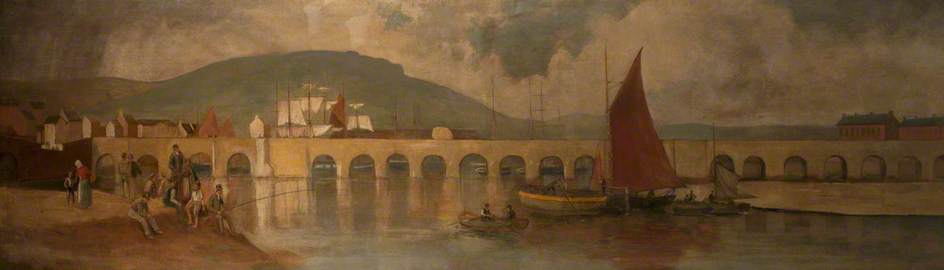
THAT ABANDONED SOIL
I have been reading the letters written by Belfast poet James Arbuckle, approaching 40, to his childhood friend Tom Drennan. James ends a letter of 12 August 1737:
‘But whither am I rambling? I talk as if I were walking with you on the Long-Bridge, or the Cave Hill. Indeed, when I think on subjects of this nature, the memory of those places always occurs to me, by a very natural association of ideas. You will pardon me if, upon such occasions, you constantly occupy a place in the landskip; since it is no contemptible proof how truly and sincerely I still continue, my dear Tom, Your most affectionate friend.’
James writes from Dublin to Tom in Belfast, an arduous journey then by ship or on horseback and the friends may not have met again before James’ death in 1742. His letters take me back, to the 1960s only, when I walked the same hills with a friend no longer here, talking like James and Tom about politics and poetry and hopes for the future. Belfast is a continent away now, and it’s years since I’ve visited, but it is often in my thoughts. Having no Tom to share them with, and finding often more interesting material in Irish blogs than in books, I thought I’d start one of my own. About Irish history and writing and exile. James and Tom, I think, would have liked blogs. James wrote an essay about essays, their ‘loose and negligent manner’, that should be like a conversation between friends; he much preferred essays to the ‘scrupulous nicety and exactness of composition [of] a formal and regular treatise’.
James was a poet and also a journalist, in the habit of sending his work to Thomas for criticism. They had grown up together in Belfast and both were then students at Glasgow University. The poem James sent on 12 August 1737 was probably Ode to the Dublin Society, a poem commissioned by some well-meaning gentlemen hoping to improve Irish society. It talked about how Ireland could be transformed by economic development- the linen industry could make it to Britain what Egypt had been to ancient Rome. Hmm. James’s literary career had not been quite the success he hoped for. Briefly feted in Scotland as a student he had moved to Dublin as editor of a literary paper, the Dublin Weekly Journal. But after a few years it folded, and he took a job as a clerk in the government Revenue office. Tom meanwhile became a clergyman, Rev Thomas Drennan MA, minister of the First Presbyterian Church, Belfast. But Thomas was no brimstone preacher. He, James and their other childhood friend Francis Hutcheson, the philosopher, all Glasgow students, had rejected any form of religion that made men ‘morose and gloomy’. Hutcheson said that ‘the Importance of any Truth is nothing else than its Moment, or Efficacy to make Men happy’. Thomas became one of the founders of the ‘Non-Subscribing Presbyterian’ church. They were Calvinists who rejected Calvin and any other authority, radical individualists who believed that it was no sin to take pleasure in the world. Very close to Unitarians.
For James the greatest pleasure was the excitement of inspiration. In his brilliant long poem Snuff he described the trials of a writer dozing at his desk, who takes a pinch of the magic powder:
In that short Respite from her lab’ring Throws,
The Soul recruits, then with new Vigour flows;
Now Images that long had molding been
With mighty Pain, jump ready molded in,
The found’ring Muse revives, she mounts on high,
Frisks in the Air, and curvets in the Sky,
With Ease the Bard rings round the sounding Chimes,
Pleas’d with the Toil of coupling ready Rhimes,
And does not longer wildly foam and puff,
Champing the Jingle—He’s reliev’d by Snuff.
There is no record of poems by Tom but he found other pleasures. In middle age (in 1741) he married a fine young woman, somewhat above his social station, who kept him in a comfortable life. In one of James’s last letters he gives advice on how to pay court to a superior lady. James did not marry and was dead by 1742. He was driven to a solitary life perhaps by physical handicap; he walked with crutches. Snuff has a description of a cripple labouring across Glasgow Green, who stops for a pinch of snuff, and reflects on the consolations of poetry.
THO’ in some solitary pathless wild,
Where Mortal never trod, nor Nature smil’d,
My cruel Fate should doom my endless Stay
To saunter all my ling’ring Life away,
Yet still I’ll have Society enough,
While blest with Virtue, and a Pinch of Snuff;
Enough for me the conscious Joys to find,
And silent Raptures of an honest Mind.
Fantastic- ‘Virtue and a pinch of snuff’- what more does a man need?
In their Belfast childhood, shortly after the British revolution of 1688-90, Tom and James’s families were among the early Scottish settlers in the north of Ireland. Belfast was a small town, mostly inhabited by Scots. The valley of the river Lagan was still the fresh green breast of a new world (although the artist in the picture above has hinted at what was to come in the factory on the right). I live now in Jerusalem in a society that makes me think of Belfast and that is even more divided by conflicts of settler and native. The generation of James and Tom and Francis Hutcheson were not only lovers of art but radical liberals (then called Whigs). They were aware of the hazards of mixed populations, but knew also that their world was already being changed by social mobility. Mixing with those of different background and faith was inevitable and, properly managed, ought to enable men to learn and grow, not fight. This comes from James’s essay on sectarian divisions under the Irish penal laws:
‘What then are Bigots, at the best, but the Dupes of crafty and designing Men, who make them the supports of their Tyranny and Oppression?… In those States where Men are obliged by penal Laws to be of one Faith, and one Mind, there is little to be met with among the common People, but Barbarity and gross Ignorance, joined with a stupid Indolence and Inappetency to every Enjoyment in Life beyond Necessity; among the great ones perpetual Frolick and Debauchery; and the Soil wherein they live, however blest with all the Advantages of Nature, everywhere wearing a Face of Poverty and Desolation… [We must] enlarge our Thoughts with Sentiments of Humanity and Generosity for those who differ from us; since by doing otherwise, besides the Injury done to innocent Persons at present, we shall lay a Foundation for so many future Calamities to our Country and Posterity.’
I am interested in these men because they give me an idea of a background I might identify with. Another of James’s poems spoke of ‘that abandoned soil where nature never smiled’. As a teenager in the 1960s that was pretty much how I saw the Belmont suburb of Belfast, where I had been sent to live in term-time with a great-aunt. I was at a school, the Belfast ‘Inst’, founded by Tom’s son William, who was also a founder of the United Irishmen. They were a group that tried to bring the French Revolution to Ireland in the 1790s. That should have been a heritage to be proud of but I wasn’t and exile seemed then, as the ‘Troubles’ were starting, to be the only future.
I read an obituary recently in a local Ulster paper (it’s wonderful to be able to read these things online); it used a phrase I heard so many times- ‘a loyal son of Ulster’. I never wanted to be a loyal son of Ulster. I don’t want to make a fetish of a particular kind of remembrance. I am at best half an Ulsterman (part-Jewish too); I’ll come on to Jewish heritage maybe another time, and at the very curious way that Irish people map their own conflict on to the land of Israel. But although I don’t want to be a loyal son nor do I want to have my heritage taken from me. I want, if I can, to choose it.
James has some very interesting lines about heritage at the end of Snuff. It takes him back again to the walks by the River Lagan (with Tom perhaps), when he decided to follow the career of a writer. He doesn’t want to be a minister like Tom, or a merchant like his own father. There is a hint also of the rejection of a Calvinist God. Instead he rejects his literal forefathers in favour of chosen forefathers, in favour of an imagined community of poets. He was walking, he said, by the River Lagan, when the Muse claimed him, on what he called ‘those grovy Banks’:
Where first the Beauties of the Muse I saw,
And heard the Summons with a filial Awe.
“Youth, (so she spoke) I have adopted thee,
Renounce thou therefore all the World for me.
The flitting Joys of giddy Fortune shun,
Nor in the crooked Paths of Av’rice run.
No other Wish indulge, nor Ways explore,
Than did thy great Forefathers all before;
Like Them, my Honours shall thy Temples show,
If like them, thou shalt all for me forego.”
 Lenox.Drennan